UK Government Consultation on RF Jammers: What It Means for Your Business
#RFJammers #UKGovernment #RFDetection #WirelessSecurity #BusinessSecurity #DSIT #BurglaryPrevention #SignalSafePro
If you run a hotel, a corporate office, a school, or any site where confidentiality and guest safety matter, there's a quiet gap in UK law you should know about: it isn't currently illegal to simply possess a radiofrequency jammer. Using one is a criminal offence. Owning one, in most cases, isn't — yet.
That's about to come under scrutiny. On 10 April 2026, the Department for Science, Innovation and Technology (DSIT) opened a call for evidence on radiofrequency jammers and the legal framework that governs them, inviting views from businesses, security professionals, and members of the public on whether possession should be criminalised and how enforcement could be tightened.
For anyone responsible for physical or commercial security, this is worth understanding — both because it signals where regulation may be heading, and because it confirms what many in the security industry already know: jammers are a live, growing threat, and the law hasn't fully caught up.
What's Actually Being Proposed
DSIT's document doesn't set out firm new rules. It's an information-gathering exercise, designed to build the evidence base before any legislation is drafted. But the direction of travel is clear from the questions it's asking.
At the moment, the relevant law sits mainly in the Wireless Telegraphy Act 2006, which makes it an offence to use equipment that interferes with wireless communications, alongside the Electromagnetic Compatibility Regulations 2016 and the Radio Equipment Regulations 2017, which govern what equipment can legally be manufactured, imported, or sold in the UK. None of these frameworks currently prohibit simply owning a jammer.
DSIT is now asking whether that should change, pointing to a precedent already sitting in the Crime and Policing Bill: a proposed offence of possessing an electronic device where there's reasonable suspicion it will be used for vehicle theft. The call for evidence asks directly whether a similar "possession" offence should be introduced for RF jammers generally.
Why This Is on the Government's Radar
The consultation document is candid about the scale of the problem. It describes jammers as increasingly used to enable vehicle theft, shoplifting, burglary, and organised fraud, alongside more serious infrastructure risks — jamming can disrupt Position, Navigation and Timing (PNT) signals that aviation, maritime transport, emergency services, and financial systems all depend on.
Crucially, DSIT also acknowledges a practical enforcement problem that security professionals will recognise immediately: proving someone used a jammer requires evidence of active interference, which is difficult when devices are small, portable, and switched on only briefly. Ofcom and police can seize a jammer, but struggle to prosecute the more serious offence under the current law. That evidential gap is precisely why possession-based offences are now being considered — it's easier to prove someone had a jammer than to prove the exact moment they used it.
What This Means for Hospitality, Corporate, and School Environments
This consultation is framed around vehicle theft and organised crime, but the underlying issue — that jammers are cheap, widely available, and largely unregulated at the possession level — is exactly what drives their use in the environments Signal Safe Pro works in every day.
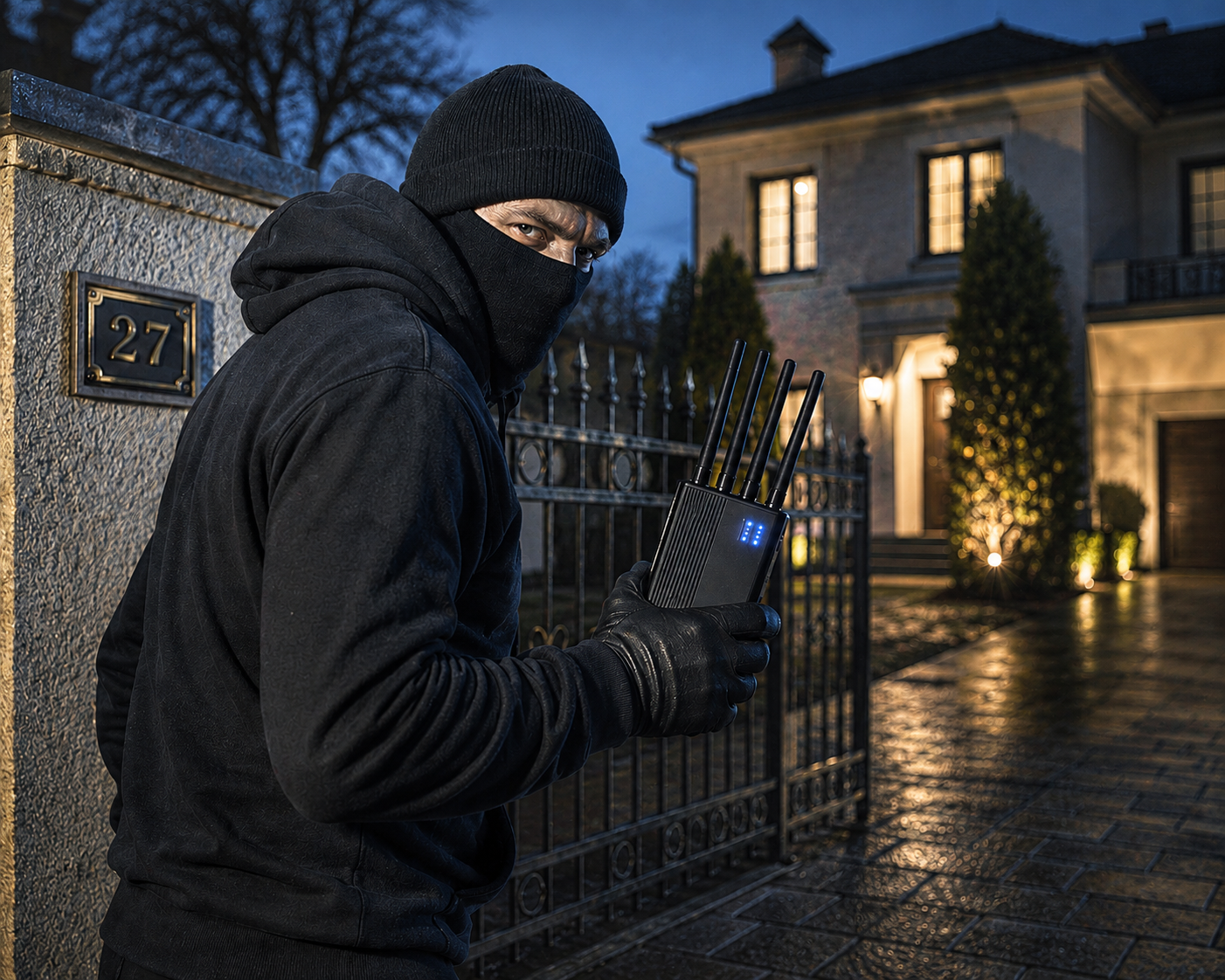
Jammers turn up in some of the same contexts as hidden cameras and covert listening devices: disabling Wi-Fi-connected security cameras before a burglary, defeating card payment terminals at unattended sites, or interfering with wireless alarm systems. A guest room, a boardroom, or a school site with wireless-dependent security is only as strong as its weakest, unmonitored frequency.
The uncomfortable truth the government's own document highlights is that the law currently punishes the act, not the tool. Until legislation changes, the practical burden of protecting a site from jamming and covert RF devices falls on physical detection and monitoring — not on the hope that possession alone will be prosecuted.
The Takeaway
Whether or not this call for evidence leads to a new possession offence, it confirms two things worth acting on now:
- Government itself recognises jammers as a growing, under-regulated threat, with real financial, safety, and reputational consequences for the businesses that fall victim to them.
- Detection remains the practical front line. Even if possession becomes illegal, enforcement will still rely on the same evidential challenges DSIT describes — devices are small, easily concealed, and used briefly. RF detection technology addresses that gap directly, identifying jamming and covert transmission activity in real time, regardless of what the law eventually says about ownership.
The call for evidence closed to public responses on 8 May 2026, and any resulting legislation will take time to materialise. In the meantime, the risk this consultation describes — jammers used to defeat wireless security, payment systems, and communications — is already here.
If you want to understand your site's exposure to RF jamming or covert device risks, get in touch with Signal Safe Pro to discuss detection solutions built for hospitality, corporate, and education environments.