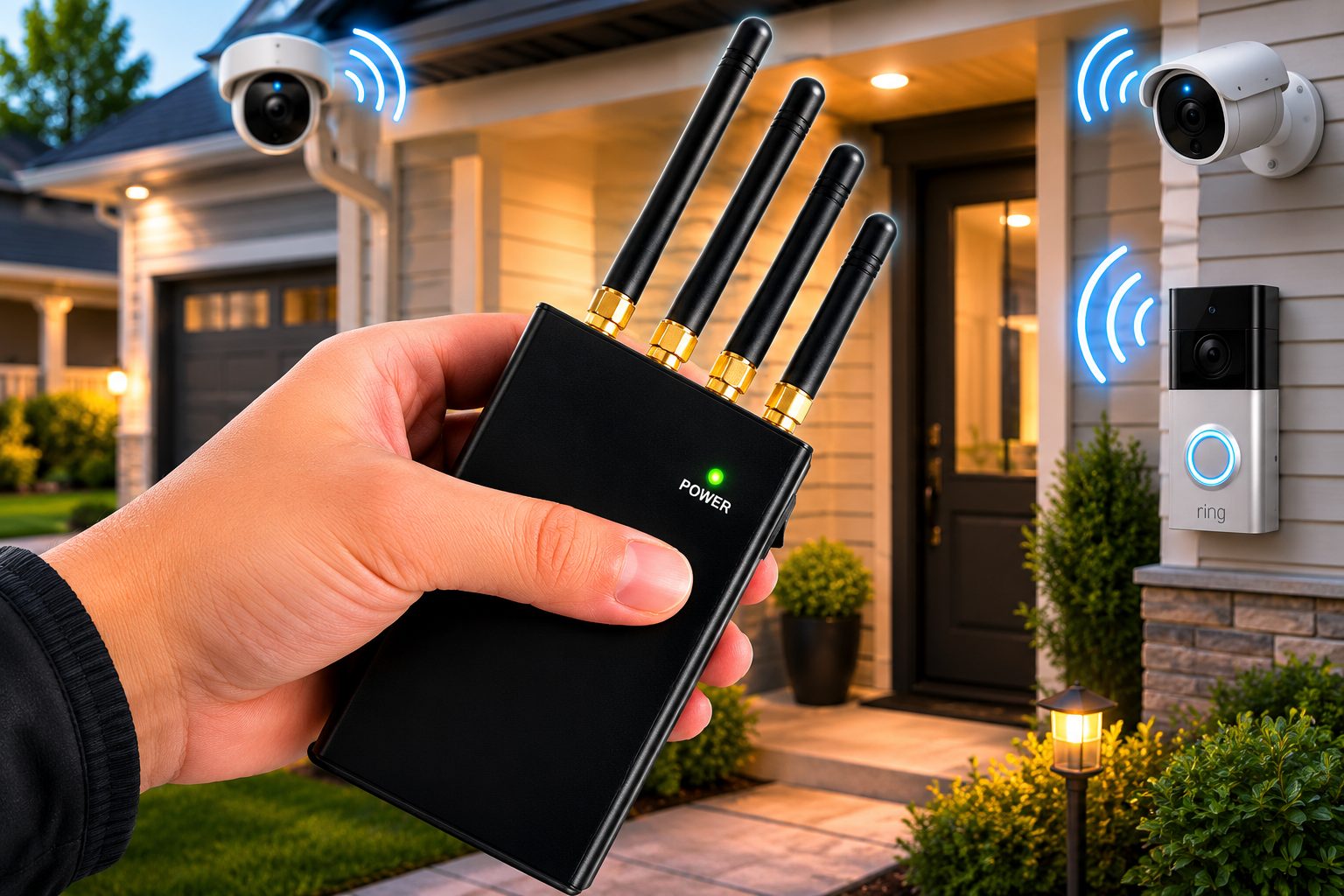
Wi-Fi Jammers and Burglary: How a £40 Device Is Disabling Home Security Systems
Published by Signal Safe Pro | Security Intelligence Blog
#WiFiJammers #HomeSecurity #BurglaryPrevention #SmartHomeSecurity #RFDetection #WirelessCameras #StaySafe #SignalSafePro
You've invested in a smart doorbell. You've got wireless cameras covering your driveway and back garden. You've linked everything to an app that pings your phone the moment anything moves. Your home feels protected.
But what if a criminal could silence all of it. Every camera, every sensor, every alarm with a device they bought online for less than the cost of a meal out?
That's exactly what's happening. Across the United States, the United Kingdom, and beyond, a new generation of tech-savvy burglars is deploying Wi-Fi jammers to render modern wireless security systems completely useless and law enforcement agencies around the world are struggling to keep pace.
What Is a Wi-Fi Jammer and How Does It Work?
A Wi-Fi jammer is a device that broadcasts radio frequency signals on the same bands used by wireless networks typically 2.4 GHz and sometimes 5 GHz at a power level that overwhelms and disrupts legitimate communications. When activated near a property, it causes wireless cameras to lose their connection, smart alarms to go offline, and video footage to either stop transmitting or degrade into useless static.
As one IT expert explained to Houston news station KHOU following a burglary in Bellaire, Texas, the device works by "overwhelming the signal and causing what's called a packet disruption" effectively flooding the wireless channel until nothing else can get through. Crucially, it does this silently, from outside the property, without the homeowner receiving any alert. The security system doesn't trigger. No alarm sounds. No notification reaches your phone. The cameras appear to simply lose signal, something most people would dismiss as a routine connectivity hiccup.
And unlike the sophisticated cyberattack it effectively is, the hardware can be assembled in under 30 minutes for around £50.
A Problem That Has Been Growing for Years
Wireless jamming has been technically possible for decades, but it remained largely theoretical as a residential burglary method. That changed as consumer Wi-Fi security systems became ubiquitous and as cheap jammer hardware flooded online marketplaces.
Reports of jammers being used in domestic burglaries began surfacing as early as 2020, with a notable early case involving a Ring wireless doorbell that failed to capture a porch theft after a Wi-Fi deauthentication attack. By 2021 and 2022, reports were growing in frequency across the United States and Europe. By 2024, law enforcement agencies in multiple countries were issuing public warnings.
Today, prices for commercially available jammers range from as little as £30 to over £800, and they are trivially easy to source online, despite being illegal to own or operate in most jurisdictions.
Real Cases: The Threat by Numbers
Minnesota, USA — Nine Burglaries, Zero Footage (2024)
One of the cases that brought the issue to national attention in the United States involved a serial burglar in Edina, Minnesota, suspected of using a Wi-Fi jammer across nine separate break-ins. In each case, the modus operandi was the same: the jammer was deployed to ensure that no incriminating video evidence would be available to investigators. Police were left with crime scenes but no footage and no leads.
Los Angeles, California — "The Hottest Device Today" (2024–2025)
The Los Angeles Police Department issued a public warning in early 2024 after a series of residential burglaries in the city's Wilshire area, where groups of three to four suspects were observed using Wi-Fi jammers before entering properties. By March 2025, LAPD Chief Jim McDonnell described jammers as "a universal key and the hottest device today" as criminals attempt to bypass the newest technology.
In one documented LA case, a family had £20,000 worth of property stolen after a jammer costing just £30–£40 was used to disable their entire wireless security setup.
Phoenix and Scottsdale, Arizona — Organised Crime at Scale (2024)
Phoenix Police documented over 111 jammer-assisted burglaries across the greater Phoenix metropolitan area in a single year, linked to organised South American Theft Groups. The groups targeted affluent neighbourhoods, deploying jammers alongside counter-surveillance techniques including placing hidden cameras near target properties to monitor residents' routines before striking. Total estimated losses across the spree exceeded £2.4 million.
Massachusetts — £3.2 Million Jewellery Heist (2024)
Massachusetts State Police broke up a sophisticated burglary ring in April 2024 after a nine-month investigation, charging four individuals including two brothers with 95 counts of burglary and breaking and entering. The gang had used Wi-Fi jammers to disable home security systems across 25 communities, stealing over £3.2 million in jewellery, gold, diamonds, and cash. Prosecutors described the group as "very sophisticated," noting that they researched targets in advance and struck only when families were away from home.
Houston, Texas — 60+ High-Value Homes Targeted (2025–2026)
A South American theft network was linked to more than 60 burglaries across the Houston area by early 2026, with investigators confirming that suspects deployed signal jammers to neutralise alarm and Wi-Fi systems as part of a consistent operational playbook. Suspects also repositioned security cameras physically before entry. The group is believed to be part of a nationwide operation also active in California, Florida, Wisconsin, and New York.
Bellaire, Texas — Caught on Camera, Barely (2025)
In a rare piece of documented footage, three suspects at a Bellaire property were seen approaching a security camera holding up a backpack believed to contain a jammer that caused the video feed to degrade into fuzzy, unusable images. The footage illustrated precisely how the tactic works in practice: not a complete blackout, but enough disruption to prevent identification.
New Jersey — Jammer Cuts Off Homeowner's Emergency Call (2024)
In perhaps the most alarming documented case, a New Jersey homeowner was present when thieves broke in and found he could not call for help because the jammer had cut off not just his Wi-Fi but also his cellular signal. He escaped unharmed, but the incident underlines a danger that goes well beyond lost camera footage.
United Kingdom — Reports Rising Nationally (2025)
Security installers across the UK have reported a notable increase in jammer-related incidents, with cases emerging in Suffolk and other regions. Wireless security cameras and video doorbells now installed in more than a third of UK homes are the primary target, and the small, easily concealed devices are described as "worryingly cheap to buy online." The UK's leading security monitoring organisations have begun advising clients to move away from fully wireless setups for high-risk properties.
UK and Germany — Alarm Systems Bypassed (2021 onwards)
Multiple reported burglaries in the UK and Germany have involved jammers being used specifically to block not just video feeds but silent alarm signals allowing entry while the system registered no intrusion at all. The victim and their monitoring company remained unaware until the thieves had long gone.
Why This Matters Now More Than Ever
The reason jamming has become such an effective tool is, paradoxically, a consequence of the enormous success of smart home security. Wireless cameras, smart doorbells, and app-connected alarm sensors have put genuine security within reach of millions of homeowners at affordable prices. But the same convenience that makes these systems appealing, no cables, quick installation, remote monitoring is precisely what makes them vulnerable.
Every device that communicates wirelessly is, to some degree, susceptible to interference. And as smart home adoption has grown, so has the number of properties where a single jammer can disable an entire security ecosystem in one press of a button.
There is also the secondary risk increasingly flagged by security experts: advanced jammers can be used to monitor smartphone signals, potentially allowing criminals to track a homeowner's location and confirm they are away before proceeding with a break-in.
Is It Legal to Own a Jammer?
In short: No, not in most of the countries where these incidents are being reported.
In the United States, Wi-Fi jammers are banned under the Communications Act of 1934 and FCC regulations. Owning, using, or selling a jammer can result in substantial fines and imprisonment. Some states, including Oregon, have gone further by classifying jammers as burglary tools, giving police additional powers to prosecute their possession.
In the United Kingdom, the use of jammers is prohibited under the Wireless Telegraphy Act 2006. The Ofcom regulator takes a firm stance on interference devices, and law enforcement has powers to seize and prosecute their use.
Across the European Union, the Radio Equipment Directive governs wireless devices, and new standards introduced in 2025 (EN 18031-1) place additional obligations on wireless product manufacturers to protect against interference.
The problem, of course, is that illegality is no barrier to criminals. Jammers are manufactured primarily in countries outside these regulatory frameworks and are readily available through overseas online retailers.
How to Protect Your Property
Awareness of the threat is the first step. The second is adapting your security setup to reduce your vulnerability. Here is what security professionals currently recommend:
Supplement wireless with wired. A hybrid system combining wireless cameras with at least some hardwired devices significantly reduces your exposure. A jammer cannot affect a camera transmitting over a physical cable, and footage recorded locally to a DVR cannot be intercepted remotely.
Choose cameras with local storage. Devices that record to an onboard SD card or local NVR will continue capturing footage even when Wi-Fi is disrupted, rather than relying solely on cloud upload. This is one of the most practical mitigations available today.
Use overlapping camera angles. A jammer can be pointed at a specific camera to disrupt it; having multiple cameras covering the same area from different positions makes full suppression significantly harder.
Consider 5 GHz equipment where available. Many consumer jammers target the 2.4 GHz band. Cameras that operate on 5 GHz, or dual-band devices that can switch frequencies automatically, provide an additional layer of resilience.
Invest in a monitored alarm with cellular backup. If your alarm system communicates with a monitoring centre via a SIM card rather than (or in addition to) Wi-Fi, it maintains a communication path even when your broadband signal is jammed.
Enable connectivity alerts. Some smart security platforms can notify you if a device loses its network connection unexpectedly. An alert that your camera has gone offline at 10pm might be a connectivity issue — or it might be something else.
Consider a radio frequency (RF) detector. Devices designed to detect the presence of unusual radio frequency emissions can alert you to active jamming in your vicinity, the same underlying technology used in professional-grade counter-surveillance equipment. Talk to info@signalsafepro.com for solutions.
The Broader Picture
What makes the jammer threat particularly challenging for law enforcement is the combination of low cost, high effectiveness, and difficulty of forensic detection. Unlike a smashed window or a forced lock, a jammer leaves no physical evidence of its use. By the time a homeowner notices their cameras have gone dark, the device has been switched off and pocketed.
The FBI, LAPD, and police forces across the UK have all acknowledged the growing prevalence of this tactic. It is no longer a fringe technique used by a handful of technically sophisticated criminals, it is becoming a standard tool of organised burglary networks operating across multiple countries.
The good news is that the countermeasures are available, practical, and increasingly affordable. The key is understanding that a wireless security system, however sophisticated is only as secure as its most vulnerable component. In 2025 and beyond, that vulnerability is increasingly the radio frequency link between device and network.
Signal Safe Pro specialises in RF detection and counter-surveillance technology for residential, commercial, and professional environments. Our range of signal detectors and RF scanners is designed to identify the presence of jamming devices and other unauthorised wireless transmissions, giving you an early warning when your security environment is being actively interfered with.
To learn more about our products, visit signalsafepro.com.