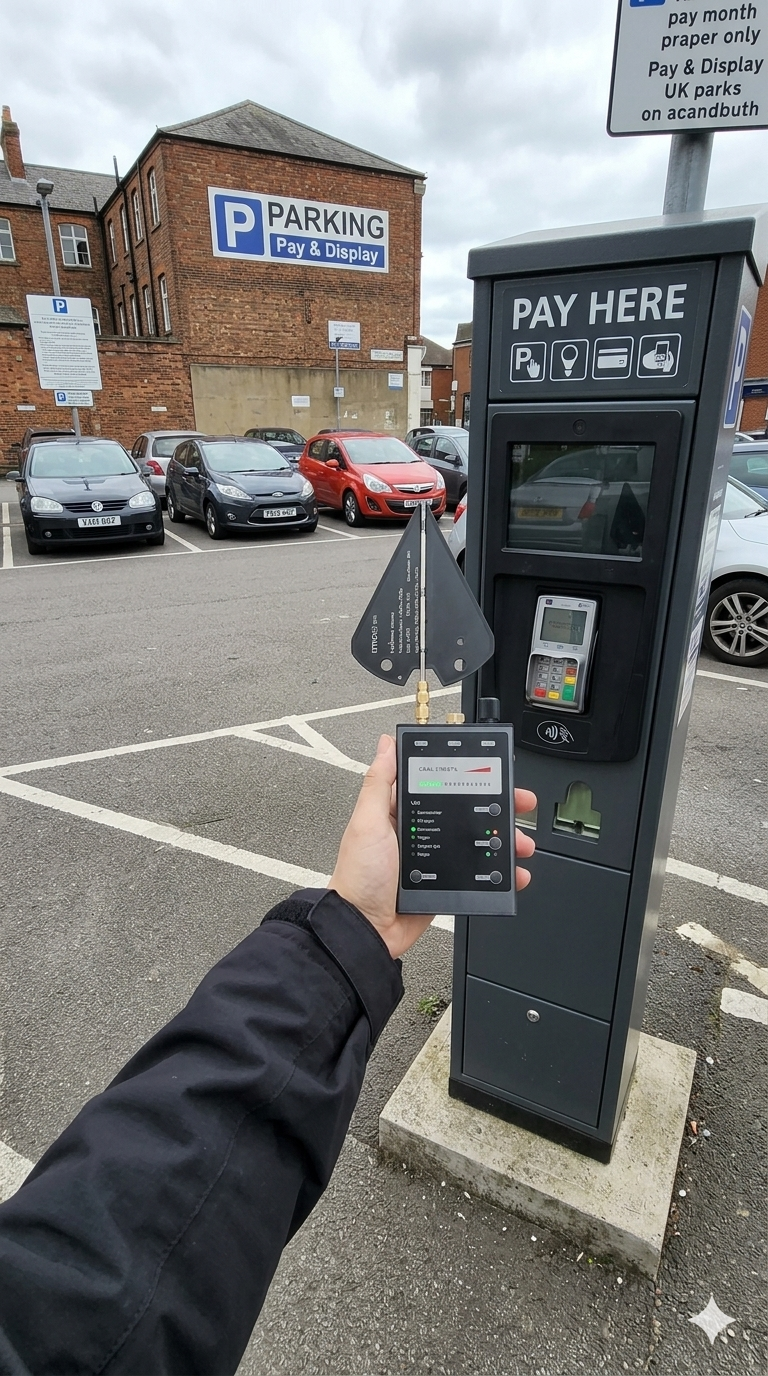
Bluetooth & Wi-Fi Skimming Attacks Are Rising: Why Unattended Payment Machines Need RF Detection
#RFDetection #CardSkimming #UnattendedPayments #EVCharging #PaymentSecurity #FraudPrevention #CyberSecurity #SignalSafePro
Security & Infrastructure Analysis | 2026
The modern unattended payment machine is no longer a simple cash box with a keypad.
Today’s parking meters, EV charging stations, ATMs, ticket kiosks, and petrol pumps are sophisticated connected systems operating in dense wireless environments. Many now rely on:
- Wi-Fi connectivity
- Bluetooth communication
- RFID and NFC payment systems
- Cellular backhaul
- Wireless maintenance access
- Mobile app integration
These technologies have improved convenience enormously.
They have also dramatically expanded the attack surface.
As wireless-enabled infrastructure spreads across cities and transport networks, attackers are increasingly exploiting radio-frequency (RF) vulnerabilities to conduct skimming attacks, intercept communications, disrupt services, or gain unauthorised access.
The result is a growing need for continuous RF monitoring and detection technology within unattended payment environments.
RF signal detectors are rapidly moving from specialist counter-surveillance tools to essential frontline security infrastructure.
The Core Problem: Wireless Attack Surfaces Are Invisible
Traditional physical security focuses on visible threats:
- Forced entry
- Card skimmers
- Vandalism
- Tampering
- Camera surveillance
But many modern attacks never physically touch the machine.
Instead, they exploit invisible wireless communication channels operating around the device.
A malicious actor sitting in a nearby vehicle may be able to:
- Intercept Bluetooth communications
- Deploy rogue Wi-Fi access points
- Spoof maintenance devices
- Conduct relay attacks
- Jam communications
- Scan for vulnerable interfaces
- Exfiltrate payment data wirelessly
Without RF monitoring, these attacks can remain undetected for long periods.
Why Parking Machines Are Particularly Vulnerable
Parking payment terminals present a uniquely attractive target for attackers.
They are:
- Unattended for long periods
- Located outdoors
- Physically accessible
- Widely distributed
- Network-connected
- Frequently equipped with contactless payment systems
Many modern parking systems also use:
- Bluetooth Low Energy (BLE)
- Wi-Fi mesh networking
- NFC payment readers
- Mobile-app integrations
This creates multiple RF entry points.
Unlike indoor retail environments, parking infrastructure often lacks:
- Active monitoring
- Security personnel
- Continuous surveillance
- Immediate anomaly detection
Attackers know this.
The Rise of Wireless Skimming and Relay Attacks
Traditional card skimming involved physically attaching devices to ATMs or payment terminals.
Modern wireless skimming increasingly relies on short-range radio technologies instead.
These attacks may involve:
- Bluetooth skimmers hidden inside machines
- Rogue Wi-Fi maintenance portals
- RFID relay attacks
- NFC interception devices
- Covert data exfiltration modules
The shift toward wireless skimming is significant because the malicious hardware may be completely internal and invisible externally.
RF detection becomes one of the only practical ways to identify suspicious transmissions.
Real-World Case Studies
Case Study: Bluetooth Skimmers Found Inside Fuel Pumps
Fuel pumps have become one of the most heavily targeted unattended payment environments.
Investigators in multiple US states have discovered Bluetooth-enabled skimming devices concealed inside petrol pump cabinets.
These skimmers transmitted stolen card data wirelessly to nearby attackers, allowing criminals to harvest payment information without reopening the pump.
The key danger was operational invisibility:
- No visible external skimmer
- No obvious tampering
- No requirement for attackers to revisit the device physically
The stolen data could simply be downloaded wirelessly from a nearby car.
RF signal detectors would have identified unexpected Bluetooth transmissions originating from the pump infrastructure itself.
Case Study: EV Charger Wireless Attacks — “Brokenwire”
Researchers from the University of Oxford demonstrated a real-world wireless attack against EV charging infrastructure known as Brokenwire.
The attack targeted the Combined Charging System (CCS), one of the world’s most widely used EV charging standards.
Researchers showed that attackers could wirelessly disrupt charging communications from significant distances using low-cost RF equipment.
The implications were substantial:
- Charging sessions aborted remotely
- Entire charging fleets disrupted simultaneously
- No physical tampering required
- Attacks conducted from nearby vehicles or buildings
The researchers demonstrated successful attacks against multiple real-world chargers and vehicles using off-the-shelf radio hardware.
As EV charging infrastructure becomes increasingly connected through Wi-Fi, Bluetooth, RFID, and mobile applications, continuous RF monitoring becomes critically important.
Case Study: Bluetooth Exploits Against Smart EV Chargers
At Pwn2Own Automotive 2024, security researchers demonstrated attacks against multiple commercial EV charging systems, including the Autel MaxiCharger and JuiceBox 40.
Researchers successfully achieved code execution against charging devices using Bluetooth-range attacks.
The chargers exposed multiple wireless interfaces, including:
- Bluetooth
- Wi-Fi
- LTE connectivity
- Ethernet services
The attacks showed that modern charging infrastructure increasingly resembles networked IoT environments rather than isolated electrical equipment.
This dramatically changes the security model.
RF anomaly detection offers one of the few practical methods for identifying:
- Unexpected Bluetooth activity
- Rogue wireless connections
- Unauthorised pairing attempts
- Persistent nearby scanning behaviour
Case Study: ATM Wireless Vulnerabilities
Although ATM skimming is often associated with card overlays, attackers have increasingly adopted wireless methods to retrieve stolen data remotely.
Security researchers and criminal investigations have documented cases where Bluetooth-enabled skimming modules transmitted harvested payment data wirelessly to nearby operators.
The advantage for criminals is obvious:
- Reduced physical exposure
- Faster data collection
- Less need to revisit compromised devices
- Lower risk of detection
In many deployments, ATM cabinets are rarely scanned for RF anomalies.
This creates ideal conditions for covert wireless exfiltration.
Petrol Pumps: A High-Risk RF Environment
Petrol stations combine several high-risk factors:
- Continuous public access
- High transaction volumes
- Outdoor unattended terminals
- Remote locations
- Legacy infrastructure
- Limited physical inspections
Research into fuel pump skimming devices has shown how attackers increasingly integrate wireless communication modules into skimmers for remote operation.
A Bluetooth-enabled skimmer hidden inside a pump may remain operational for weeks before discovery.
RF signal detectors can identify:
- Persistent Bluetooth emissions
- Unauthorised Wi-Fi hotspots
- Rogue RF devices
- Suspicious transmission patterns
…long before fraud reports begin appearing.
Why EV Charging Stations Need RF Monitoring
EV charging stations are rapidly evolving into highly connected edge-computing devices.
Modern chargers frequently include:
- Bluetooth pairing
- RFID authentication
- NFC payment systems
- Wi-Fi connectivity
- Mobile app integrations
- Remote diagnostics
- Cloud telemetry
Every additional wireless interface increases the attack surface.
Researchers have repeatedly shown that EV chargers can be vulnerable to wireless exploitation and denial-of-service attacks.
As charging infrastructure expands into unattended roadside environments, RF detection becomes increasingly important for:
- Detecting rogue devices
- Identifying nearby attack attempts
- Monitoring unauthorised wireless activity
- Investigating interference incidents
- Detecting persistent Bluetooth scans
What RF Signal Detectors Actually Do
RF signal detectors monitor the radio spectrum around a protected device or environment.
Modern systems can identify:
- Bluetooth activity
- Wi-Fi transmissions
- Cellular emissions
- RFID/NFC anomalies
- RF jamming attempts
- Rogue access points
- Unusual signal strength patterns
Advanced systems may also provide:
- Real-time alerts
- Signal logging
- Device fingerprinting
- Direction finding
- Persistent threat monitoring
Unlike traditional CCTV or physical inspections, RF detection identifies threats that may otherwise remain completely invisible.
The Operational Benefits
1. Early Threat Detection
Wireless skimmers and rogue devices can often be identified before customer fraud occurs.
2. Reduced Fraud Exposure
Earlier detection reduces:
- Card fraud losses
- Liability exposure
- Regulatory consequences
- Reputational damage
3. Faster Incident Response
RF monitoring enables operators to pinpoint suspicious activity rapidly instead of waiting for fraud patterns to emerge weeks later.
4. Deterrence
Attackers prefer soft targets.
Visible RF monitoring programmes increase operational risk for criminals.
5. Compliance and Due Diligence
As wireless attacks become more common, operators may increasingly be expected to demonstrate reasonable protective measures around unattended payment systems.
Industries Most at Risk
The need for RF detection is growing rapidly across:
- Parking payment terminals
- EV charging infrastructure
- ATMs
- Petrol pumps
- Ticket kiosks
- Public transport payment systems
- Vending infrastructure
- Smart city payment networks
Any unattended machine that processes payments and contains wireless functionality is potentially vulnerable.
Why Traditional Security Is No Longer Enough
CCTV cannot see radio signals.
Tamper seals cannot detect Bluetooth skimmers.
Routine inspections often miss covert wireless implants.
The evolution of payment infrastructure requires a corresponding evolution in security strategy.
Wireless threats require wireless visibility.
Conclusion
The unattended payment industry is entering a new era of security risk.
As parking machines, EV chargers, ATMs, and petrol pumps become increasingly connected, attackers are shifting toward covert wireless techniques that are difficult to identify using traditional physical security methods alone.
The real-world attacks already demonstrated against:
- Fuel pumps
- EV charging stations
- Bluetooth-connected infrastructure
- Wireless payment systems
…show that these threats are no longer theoretical.
RF signal detectors provide one of the few practical ways to identify invisible wireless threats before they escalate into large-scale fraud, service disruption, or reputational crises.
For operators of unattended payment infrastructure, the question is rapidly changing from:
“Do we need RF monitoring?”
…to:
“How long can we afford to operate without it?”
Key Takeaways
- Wireless attacks against unattended payment infrastructure are increasing
- Parking machines, EV chargers, ATMs, and petrol pumps are all high-risk targets
- Bluetooth and Wi-Fi skimming attacks can remain invisible for long periods
- EV charging systems have already been successfully attacked wirelessly in real-world research
- RF signal detectors provide early warning of rogue wireless activity
- Traditional physical security alone is no longer sufficient