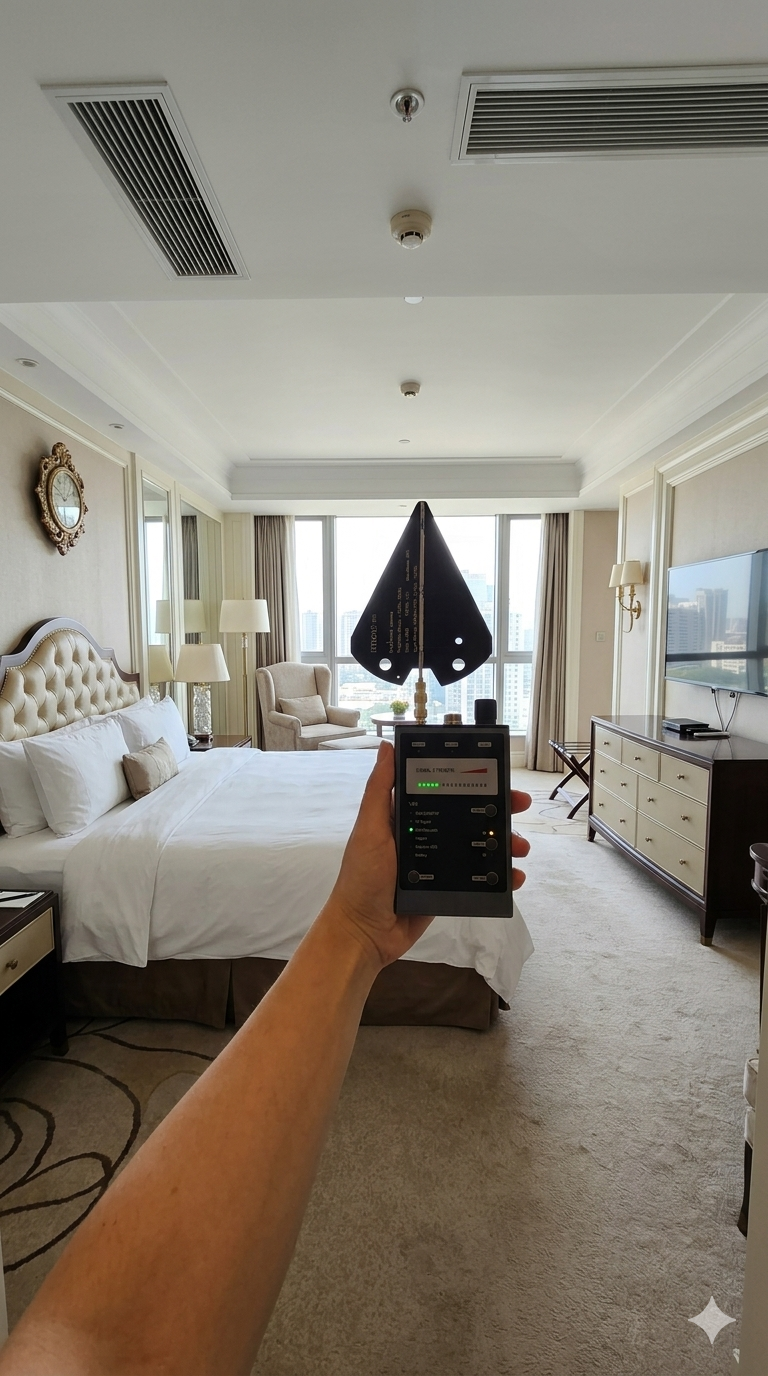
Hidden Camera Detection in Hotels & Restaurants: A Guide for Hospitality Operators
#HiddenCameraDetection #HospitalityIndustry #GuestPrivacy #HotelSecurity #DutyOfCare #RFDetection #TravelSafety #SignalSafePro
The Growing Risk Hospitality Venues Can't Ignore
Guest Privacy Desk Risk & Compliance Series 2025
A couple checks into their hotel room, exhausted after a long flight. They hang their clothes, shower, and sleep — entirely unaware that a pinhole lens concealed inside the smoke detector has been transmitting a live feed since they walked through the door.
This is not a plot from a thriller novel. It is a scenario that has played out, verifiably, in real hotels, real guesthouses, and real restaurants across the world — and it is happening with increasing frequency as covert recording technology becomes smaller, cheaper, and more accessible than ever.
For hospitality businesses, hotels, serviced apartments, short-let properties, spas, and restaurants, the presence of an illicitly placed camera in a private space represents not merely a reputational catastrophe, but serious criminal and civil liability. And yet, the overwhelming majority of venues have no systematic process for detecting them.
This article makes the case for why hidden camera detection should be a standard operational procedure across the hospitality sector. Not a luxury, not an overreaction, but a fundamental duty of care to guests.
Key Statistics
- 1 in 4 travellers who searched found an illegal camera in their rental (IPX1031, 2023)
- 58% of Americans worry about hidden cameras in vacation properties
- 30,000+ spy-cam crimes were reported in South Korea alone between 2013–2018
The Scale of the Problem
The widespread belief that hidden cameras are an exotic, rare threat is a dangerous misconception. The technology is no longer specialist.
Miniaturised cameras disguised as alarm clocks, smoke detectors, USB chargers, air fresheners, power adapters, pen holders, and bathroom fixtures are freely available online for as little as £15 to £30. They require no technical expertise to install, they can transmit live feeds over Wi-Fi, and they are extraordinarily difficult to detect with the naked eye.
A 2023 survey by property investment firm IPX1031 found that one in four guests who actively searched their vacation rental found a concealed camera. Separately, 58 per cent of American travellers reported being worried about hidden cameras in the properties they stayed in.
These are not the anxieties of the paranoid, they reflect a genuine, documented and rising threat.
The rise in incidents tracks directly with the fall in camera prices. Kenneth Bombace, chief executive of intelligence firm Global Threat Solutions, has noted that the proliferation of spy-camera incidents is driven by the increasing accessibility and low cost of such devices, combined with the public's growing ability to detect them.
As devices become cheaper and more discreet, the barrier to commission falls and hospitality venues, with their rotating guest population and expectation of privacy, are among the highest-risk environments.
“A hotel or Airbnb guest is paying for private space. There is a heightened expectation of privacy and a legal duty on the venue to protect it.”
Julian Sanchez, Cato Institute
The Legal Position: Duty of Care and Liability
Hospitality operators frequently assume that their liability is limited to cameras they themselves install. This is legally incorrect in most jurisdictions.
Legal analysis consistently indicates that a hotel has a duty to take reasonable steps to secure guest privacy and that duty extends to cameras installed by third parties, including previous guests, rogue staff members, or external actors.
In practice, this means that if a hidden camera is discovered in a guest room and the hotel cannot demonstrate that it had reasonable detection procedures in place, it faces significant civil liability regardless of who placed the device.
This principle applies equally to:
- Restaurant toilet facilities
- Spa changing rooms
- Hotel shower areas
- Fitness club changing facilities
The legal landscape varies by jurisdiction:
United States
Title III of the Omnibus Crime Control and Safe Streets Act and Fourth Amendment protections establish a clear framework: recording in spaces where a person has a reasonable expectation of privacy. Bedrooms, bathrooms, and hotel rooms is illegal.
United Kingdom
The Voyeurism (Offences) Act 2019 created specific criminal offences around recording in private spaces without consent, with sentences of up to two years' imprisonment.
European Union
GDPR and national privacy legislation impose further obligations on data controllers who fail to protect individuals from unlawful surveillance on their premises.
The financial exposure is substantial.
Erin Andrews, the American sports broadcaster, was awarded $55 million after she successfully sued a stalker who had secretly filmed her in her hotel room. That case involved an individual perpetrator, but it established the principle that victims of voyeuristic recording in hospitality settings can pursue significant damages.
Where Cameras Are Being Found
Understanding the common concealment locations is essential for designing effective detection protocols.
Hotel Rooms and Guesthouses
The most common concealment points include:
- Alarm clocks and clock radios
- Smoke detectors
- Air purifiers
- Nightlights
- Picture frames
- Decorative objects
- USB charging hubs
Cameras are typically positioned toward beds and shower areas.
Mirrors, including two-way mirrors installed in bathrooms are also a concern in older or lower-specification properties.
Bathrooms and Shower Areas
Common concealment points include:
- Toilet cisterns
- Showerhead fixtures
- Extractor fan grilles
- Air freshener units
- Toilet-roll holders
Pinhole lenses as small as 1 to 2 millimetres can be seated within grout lines, ceiling panels, or wall fixtures with virtually no visible indication.
Restaurant Toilet Facilities
Restaurants and bars face a distinct but equally serious risk in customer toilets.
The compact, often poorly lit, and infrequently inspected nature of public toilet areas makes them attractive targets for opportunistic perpetrators and organised voyeuristic networks alike.
Staff turnover and the sheer volume of users passing through create significant difficulty in monitoring access.
Spa and Changing Room Facilities
Changing rooms, steam rooms, and treatment areas represent a particularly high-risk category because guests are often unclothed.
The resulting harm and the reputational and legal damage to the venue can be catastrophic.
Common Disguises Used by Perpetrators
- Smoke detectors
- Carbon monoxide alarms
- Alarm clocks
- Clock radios
- USB wall chargers
- Power adapters
- Air freshener units
- Motion-activated nightlights
- Electrical outlet covers
- Bathroom tiles and grout
- Pen holders
- Router adapters
- Showerhead units
- Extractor fans
Case Studies: When Hospitality Failed Its Guests
Case Study 1 — Minneapolis Hotel School Trip (2019)
A group of Wisconsin students on a school trip to Minneapolis discovered hidden cameras inside air freshener canisters in their hotel rooms.
A student attempted to use the air freshener, causing a panel to dislodge and expose the camera mechanism inside.
Police later identified three concealed devices positioned toward shower and toilet areas.
The cameras had allegedly been placed by a teacher accompanying the trip.
The case demonstrated how trusted individuals can exploit hospitality environments where no detection protocols exist.
Case Study 2 — DoubleTree Hotel, Illinois
A hidden remote camera was discovered beneath a sink in a gender-neutral bathroom at a DoubleTree Hotel in Alsip, Illinois.
Legal proceedings noted that the camera appeared capable of capturing guests in a state of undress.
Investigators highlighted the absence of any routine detection procedure, meaning the device may have remained in place indefinitely before discovery.
Case Study 3 — South Korea’s “Molka” Crisis
In 2019, South Korean police revealed that approximately 1,600 motel guests across 30 locations had been secretly livestreamed via concealed cameras.
The devices were hidden in:
- Hair dryer holders
- Digital TV boxes
- Wall sockets
The footage was transmitted to a paid subscription website.
The incident prompted mass public protests and legislative reform.
Case Study 4 — Cruise Ships and Short-Let Properties
In May 2023, a Royal Caribbean passenger was arrested for installing a hidden camera in a public bathroom aboard the vessel.
In the same year, a Texas couple sued an Airbnb host after discovering hidden cameras disguised as smoke detectors in the rental property.
These incidents demonstrate that the risk extends beyond hotels to virtually all temporary accommodation environments.
Case Study 5 — Restaurant Employee Voyeurism
A restaurant employee was arrested after concealing a recording device inside a pen in a customer-accessible area.
The device remained undetected because no inspection protocol existed.
The case illustrates that threats can originate from employees as well as guests.
Detection Technology: What Is Available and How It Works
Professional hidden camera detectors generally combine multiple technologies.
1. Radio Frequency (RF) Detection
Wireless cameras transmit footage via:
- Wi-Fi
- Bluetooth
- RF bands
RF detectors scan for these transmissions and alert operators to active broadcasting devices.
Limitation:
Wired cameras or devices recording locally may not be detected.
2. Lens Detection via Infrared or Laser
Camera lenses reflect light in distinctive ways.
Infrared or laser detection tools illuminate a space and identify the characteristic reflection pattern produced by a camera lens, even if the device is powered off.
This is widely considered one of the most effective detection methods.
3. Network Scanning
Scanning local Wi-Fi networks for unrecognised connected devices can reveal streaming cameras.
However, sophisticated perpetrators may use mobile data instead of venue Wi-Fi.
4. Non-Linear Junction Detection (NLJD)
NLJD systems detect semiconductor components inside electronic devices including powered-off cameras.
These systems are highly effective but expensive, typically reserved for government or high-security use.
Professional Recommendation
For most hospitality operations, a combination of:
- RF detection
- Optical lens scanning
…will address the majority of risks.
Professional-grade combined devices are commercially available for approximately £200–£600.
However, technology alone is insufficient. Staff training and systematic inspection procedures are equally important.
Implementing a Detection Protocol
Detection must become an operational routine — not a one-off exercise.
Room and Facility Sweep Cadence
Hotels
- Sweep rooms after each guest check-out
- Conduct additional sweeps after maintenance visits
Restaurants
- Inspect toilet facilities at opening and closing
- Conduct additional checks during peak periods
Spas and Changing Facilities
- Sweep before opening each day
- Conduct checks during low-occupancy periods
Staff Training
Training should cover:
- Common concealment methods
- Visual inspection procedures
- Detection equipment usage
- Escalation procedures
Staff should treat discovered devices as potential crime scenes:
- Photograph the device in place
- Notify management
- Contact law enforcement
- Avoid removing or handling the device unnecessarily
Guest Communication and Transparency
Publicising detection procedures serves two important purposes:
- Reassures guests
- Deters perpetrators
Detection policies can be communicated through:
- Venue websites
- Booking confirmations
- Pre-arrival emails
- In-room materials
Operational Checklist
- Conduct RF and lens-reflection sweeps of guest rooms at each changeover
- Inspect all bathroom and toilet facilities regularly
- Train housekeeping and facilities staff
- Maintain signed inspection logs
- Establish a police escalation procedure
- Regularly test detection equipment
- Consider third-party professional sweeps
- Publicise the programme to guests
The Reputational Dimension
The financial and legal consequences of a discovered camera are severe.
The reputational consequences can be even worse.
A single social media post showing a discovered hidden camera can reach millions of people within hours. Media coverage typically focuses not only on the incident itself, but on the operational failures that allowed it to happen:
- No detection procedures
- Lack of staff training
- Management inaction
By contrast, venues that can demonstrate a documented, professional detection programme are in a far stronger position legally, commercially, and reputationally.
The costs are relatively modest:
- Detection equipment: a few hundred pounds
- Staff training: several hours
- Sweep documentation: minutes per inspection
The cost of a major incident, by comparison, can be incalculable.
“The risk of spy cameras is not going away — it is growing. The question for hospitality operators is not whether it can happen to them, but whether they will be prepared when it does.”
Conclusion
The obligation to protect guests from covert surveillance is no longer a peripheral concern for hospitality operators.
It sits at the heart of the trust on which the industry depends.
Guests who book hotel rooms, dine in restaurants, or use spa changing facilities assume that the environments they enter are safe, private, and responsibly managed.
That trust is increasingly vulnerable.
The technology enabling covert surveillance is cheap, accessible, and improving rapidly. The legal and financial consequences of failure are expanding alongside it.
Hidden camera detection does not require extraordinary investment.
It requires:
- Operational discipline
- Staff training
- Appropriate equipment
- Documented procedures
- Institutional commitment
The hospitality venues that act now — by implementing detection protocols, training staff, and visibly prioritising guest privacy — will be best positioned to protect their guests, their reputations, and their businesses in the years ahead.
Key Takeaways for Hospitality Operators
- Hidden camera detection is becoming a standard duty of care
- Detection technology is affordable and accessible
- Staff training is as important as equipment
- Publicising detection programmes can deter perpetrators
- The cost of prevention is far lower than the cost of a major incident