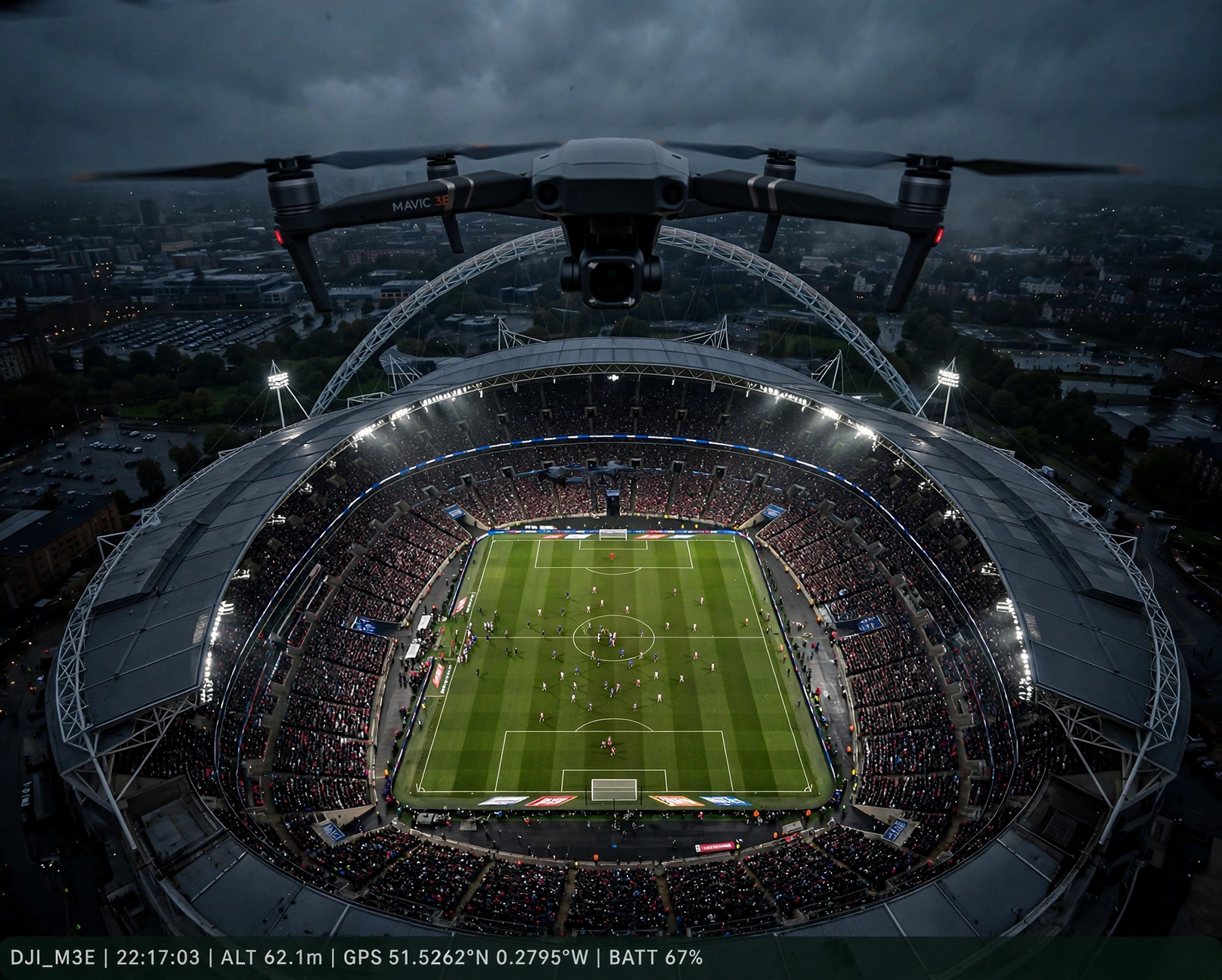
Commercial Drones and the New Threat to VIPs and Public Events
#DroneSecurity #CounterDrone #VIPProtection #EventSecurity #RFDetection
Article written by Signal Safe Pro in the category Drone & RF Security
A decade ago, a drone hovering over a stadium or a private estate was a novelty, something to point a phone camera at. Today it is a recognised line item on the risk register of event organisers, close protection teams, and government security agencies. The technology that makes drones useful, cheap, capable, and easy to fly, is the same technology that makes them hard to stop.
Why Drones Changed the Threat Model
Commercial drones solved a problem that used to require a helicopter, a long lens, or a person with legitimate access: getting eyes, or something else, into a space that was previously controlled by walls, fences, and checkpoints. A drone doesn't need a ticket, doesn't need to pass through a metal detector, and can approach from any angle, including straight up.
For VIPs, that means a residence, a motorcade route, or a private appearance can be observed from above without anyone on the ground noticing. For large public events, stadiums, festivals, political rallies, it means the airspace above a carefully secured perimeter is often the least controlled part of the venue.
The Range of Threats, From Nuisance to Weapon
Not every drone incursion is malicious, but security planners have to work through the full spectrum of intent:
- Surveillance and reconnaissance. A drone can map a venue's layout, identify security positions, time patrol patterns, and locate blind spots in camera coverage, all in advance of an attack, protest disruption, or intrusion.
- Unauthorised filming and privacy breaches. Paparazzi-style drones over private events or residences remain the most common real-world incident, but the same access can be used for stalking or intimidation.
- Smuggling and delivery. Drones have already been used to move contraband into prisons and secure sites. The same delivery mechanism could carry a listening device, a tracker, or hazardous material into a restricted area.
- Disruption. Even an unarmed drone can shut down an airport, stadium, or public event simply by being present. Regulators treat any drone near a crowd or flight path as a safety hazard, which is often enough to force an evacuation or delay.
- Weaponisation. This is the scenario security services now plan around explicitly. Commercially available drones can be, and have been, modified to carry a small explosive charge, a firearm, or a chemical dispersal device, and flown directly at a target or crowd. Off-the-shelf models can also be repurposed to drop a payload rather than carry it to impact, widening the blast radius or contamination area beyond the drone itself.
Incidents involving modified consumer drones used against political and military targets have already been documented internationally, and several plots against public figures have specifically involved drone-delivered explosives. Security agencies in the UK, US, and Europe have all issued guidance in the last few years treating small UAVs as a credible attack vector at high-profile events, not a hypothetical one.
Why VIPs and Events Are Disproportionately Exposed
Two things make VIPs and mass-gathering events attractive targets for this kind of threat, and hard to protect against it:
- Predictability. A public appearance has a known time, known location, and often a published route. That's exactly the planning information an attacker needs to launch a drone from a safe distance in advance.
- Density. A stadium or rally concentrates the target, or the audience, in one place. A drone doesn't need pinpoint accuracy to cause harm in a crowd; it needs to get within the vicinity.
Traditional perimeter security, fencing, bag checks, CCTV, vehicle barriers, was built to stop people and vehicles at ground level. None of it addresses a threat that arrives from 100 metres up.
What Counter-Drone Security Actually Looks Like
Detecting a drone early is the difference between a controlled response and a crowd already reacting to a hovering object overhead. Most professional counter-UAV setups combine several layers:
- RF detection. Almost all commercial drones communicate with a ground controller over a radio link. Detecting that signal, and the drone's telemetry and control frequencies, gives security teams a warning before the aircraft is even visible, and can often identify the operator's approximate location as well.
- Radar and visual tracking, for larger venues, used to confirm and track a detected drone once it's airborne.
- Geofencing and no-fly declarations, which rely on manufacturers' built-in restrictions and regulatory notices, but which a modified or DIY drone can simply ignore.
- Mitigation, ranging from signal jamming to physical interception, which is tightly regulated and typically restricted to law enforcement and military operators rather than private security teams.
For most organisations, the realistic and legally available first line of defence is detection: knowing a drone is present, where its signal is coming from, and how long it's been there. That's the layer that turns an unknown aerial object into an actionable security event instead of a surprise.
The Takeaway
Commercial drones didn't just add a new camera angle to the world, they added a new approach vector that most physical security plans were never designed to cover. For anyone responsible for protecting a public figure or a crowded event, the question isn't whether a drone could get close enough to matter. It's whether anyone would know it was there before it did.