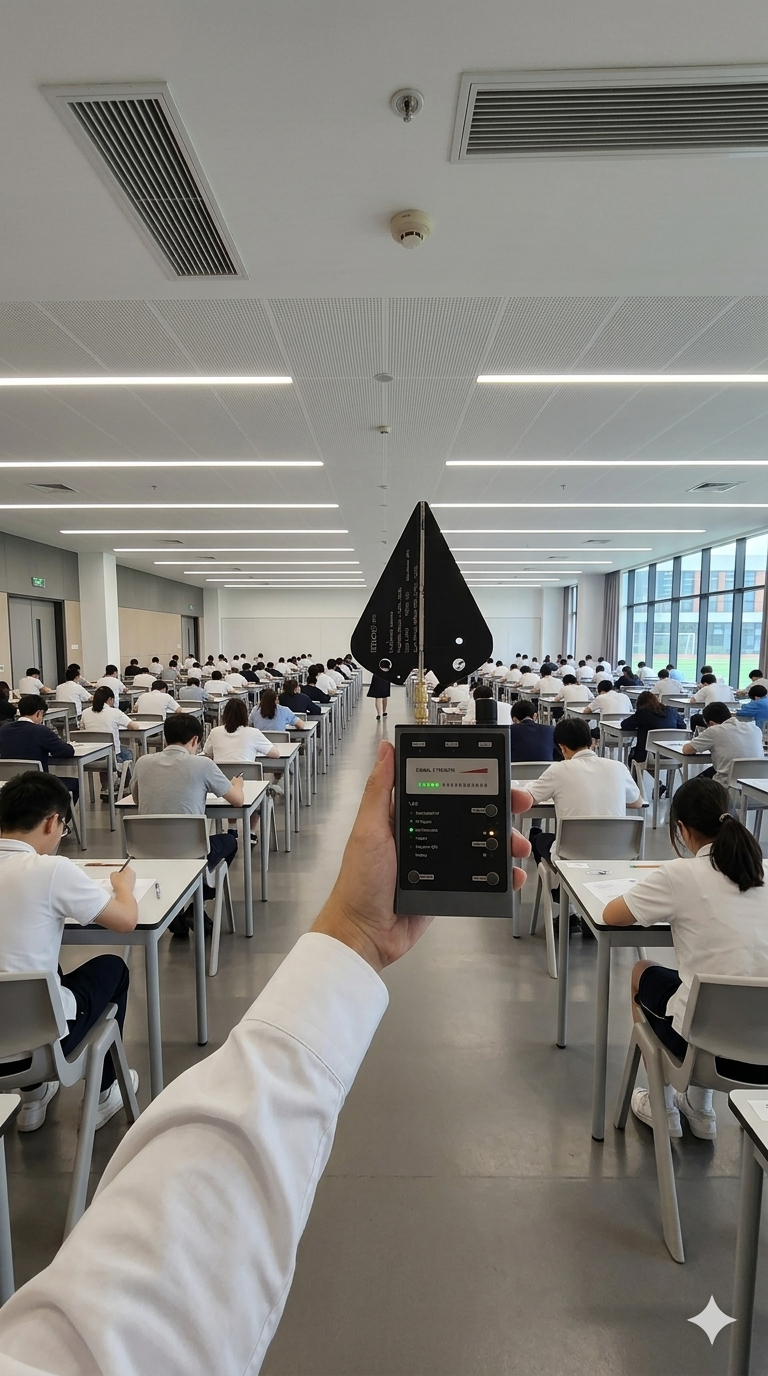
Why Every School Needs a Mobile Phone Detector in 2026
#MobilePhoneDetection #SchoolSecurity #ExamIntegrity #PhoneFreeSchools #Safeguarding #EducationPolicy #EdTech #SignalSafePro
From classroom chaos to high-tech exam cheating, the case for detection technology in education has never been stronger.
Analysis | Education Policy | 12 May 2026
The mobile phone pocket supercomputer, social lifeline, digital distraction has become one of the most disruptive forces in modern education.
While schools have long had rules prohibiting handset use in lessons, enforcement has remained stubbornly inconsistent. Detection technology is changing that conversation, and it is overdue.
From silent vibrations under the desk to sophisticated Bluetooth-enabled exam cheating rigs, the challenge facing educators is no longer simply one of willpower or school culture.
It requires a systematic, technological response one that mobile phone detectors are uniquely positioned to provide.
Key Statistics
- 97% of UK secondary school pupils own a smartphone
- 72% of teachers report phones disrupting lessons weekly
- Students are 3× more likely to underperform academically with phone access in class
- Tech-assisted exam misconduct has risen by 40% since 2020
The Disruption Problem — More Serious Than It Looks
Ask any teacher and they will tell you the same thing: the battle with mobile phones in the classroom is constant, exhausting, and ultimately fruitless when fought by policy alone.
Students who hand over their phones at the door still receive notifications via smartwatches. Those who surrender one device may retain another. And for every pupil caught, several more remain invisible.
The research is unambiguous.
Studies consistently show that merely having a smartphone visible on a desk even face-down and switched to silent measurably reduces cognitive capacity.
This phenomenon, known as the brain drain effect, occurs because a portion of the brain’s working memory remains occupied managing the temptation of the device.
“The phone doesn’t need to be in their hand to be in their head. Its presence alone is enough to fracture attention.”
Beyond individual distraction, phones create social ripples throughout the classroom.
A single notification can disrupt multiple students. Shared screens invite commentary, laughter, or conflict, all of which undermine focused learning environments.
Specific Patterns of Classroom Disruption
Covert Messaging
WhatsApp, Snapchat, and iMessage conversations frequently continue during lessons, with students developing increasingly sophisticated techniques to text without visibly looking at their screens.
Social Media Scrolling
TikTok and Instagram are engineered to maximise engagement and habit formation. Even brief exposure can reset a student’s focus threshold for several minutes.
Gaming Under the Desk
Mobile gaming increasingly resembles casual phone use in appearance, allowing students to appear attentive while disengaging completely from the lesson.
Photography and Recording
Unauthorised photography of classmates, teachers, or lesson materials raises significant safeguarding and consent concerns.
Background Streaming
Music and video streaming via earbuds divides auditory attention and degrades information retention.
Research into classroom social contagion suggests that visible off-task behaviour significantly increases the likelihood of similar behaviour in nearby students.
One phone out quickly becomes five.
Exam Cheating — The High-Tech Threat Schools Underestimate
If classroom disruption represents the everyday cost of unmanaged phone use, exam cheating represents its most acute and high-stakes manifestation.
The technology available to students who wish to cheat has evolved dramatically.
Invigilators trained to detect paper cheat sheets are poorly equipped to identify:
- Bluetooth relay devices
- Miniature earpieces
- RF transmissions
- AI-assisted cheating methods
- Hidden smartphones operating silently
Mobile phone detection technology closes this gap systematically.
Common Technology-Assisted Cheating Methods
Micro-Earpiece Bluetooth Systems
Among the most common modern cheating methods.
A near-invisible earpiece often smaller than a grain of rice receives audio streamed via Bluetooth from a hidden phone.
An accomplice outside the exam hall reads answers to the student in real time.
Standard metal detectors are often ineffective against non-metallic devices.
Smartwatches with Concealed Content
Modern smartwatches can store:
- Notes
- Formulae
- Pre-written answers
- Live communications
A quick glance at a wrist appears entirely innocent.
Phones Hidden Within Permitted Materials
Schools have recovered phones concealed inside:
- Calculators
- Pencil cases
- Water bottle labels
- Modified stationery
With screens dimmed and hidden inside folders, students can silently receive AI-generated answers.
AirDrop and Wireless File Sharing
Apple AirDrop and Android Nearby Share allow students to exchange:
- Notes
- Exam answers
- Images of exam papers
…instantly and invisibly across a room without any cellular signal.
AI Chatbot Access
A concealed smartphone with internet access gives students immediate access to AI systems capable of:
- Writing essays
- Solving equations
- Answering structured exam questions
- Generating summaries
…within seconds.
Camera-Based Remote Assistance
Miniature cameras disguised as:
- Buttons
- Pens
- Glasses
…can stream exam papers to remote accomplices who relay answers back through concealed earpieces.
Why Traditional Invigilation Methods Fail
Conventional invigilation relies heavily on visual observation.
Modern cheating technology is specifically designed to defeat that approach.
Today’s devices are:
- Tiny
- Silent
- Wireless
- Easily concealed
- Difficult to distinguish from ordinary accessories
No amount of additional invigilator staffing fully compensates for the mismatch between human observation and invisible radio-frequency transmission.
What Mobile Phone Detectors Actually Do
Modern mobile phone detection systems operate by sensing the radio frequency (RF) emissions produced whenever a phone communicates.
Unlike metal detectors, they identify the behaviour of a device rather than merely its physical presence.
Capabilities commonly include:
- Detection of GSM, 3G, 4G, and 5G signals
- Bluetooth and Wi-Fi monitoring
- AirDrop and peer-to-peer protocol detection
- Passive operation without interference
- Real-time staff alerts
- Zone-specific deployment settings
- Integration with existing safeguarding systems
Well-designed systems distinguish between authorised and unauthorised wireless activity and do not interfere with legitimate school infrastructure.
The Regulatory and Pastoral Case
In England, Department for Education guidance increasingly supports stricter restrictions on mobile phone use during the school day.
Similar approaches exist across:
- Scotland
- Wales
- Northern Ireland
- France
Detection technology provides the enforcement mechanism that gives such policies practical effectiveness.
But the argument is not solely academic.
The mental health effects of compulsive smartphone use among adolescents are now well documented, including:
- Increased anxiety
- Sleep disruption
- Cyberbullying exposure
- Reduced concentration
- Dependency behaviours
Schools that successfully maintain phone-free learning environments provide students with structured relief from an always-connected digital environment.
“Detection technology doesn’t replace trust, it creates the conditions in which trust, fair assessment, and genuine learning can flourish.”
Objections Considered
Privacy Concerns
RF detection systems do not intercept communications content.
They simply detect that a transmission is occurring, not what is being transmitted.
No messages, conversations, or browsing activity are accessed.
Cost
Fixed classroom sensors represent a one-time infrastructure investment comparable to other school technologies such as CCTV or interactive whiteboards.
Portable exam-hall systems are available at significantly lower cost.
Compared to the reputational and academic damage caused by systemic cheating, the investment is relatively modest.
Student Autonomy
Schools already enforce behavioural expectations regarding:
- Uniforms
- Attendance
- Classroom conduct
- Silence during examinations
Restricting unauthorised device use is consistent with those existing responsibilities.
Detection technology simply provides a practical enforcement mechanism.
A Clear and Urgent Case for Action
The technology used to disrupt education has evolved.
The technology used to protect education must evolve with it.
Mobile phone detectors are not a surveillance overreach. They are a proportionate response to a demonstrable and growing problem that traditional policies alone have failed to solve.
Schools that invest in detection infrastructure are likely to see measurable improvements in:
- Classroom focus
- Teacher authority
- Exam integrity
- Safeguarding
- Academic outcomes
The question is no longer whether schools can afford to deploy this technology.
It is whether they can afford not to.
Tags
Education Policy • Mobile Phones • Exam Integrity • School Technology • Safeguarding • RF Detection